
In a landmark decision that upholds the principles of religious freedom, the City of San Diego has approved the construction of All People’s Church of San Diego in the Del Cerro region of the City. This decision follows a contentious period marked by community opposition and legal challenges, ultimately culminating in a victory for the church and a reaffirmation of the Religious Land Use and Institutionalized Persons Act (RLUIPA).
Background
All Peoples Church began as a religious nonprofit corporation on January 17, 2008. The Church started as just a small group gathered in a household living room. Since then, it has grown into an established non-denominational church with a weekly attendance of approximately eight hundred (800) people. Led by Pastor Robert Herber, All People’s Church is a local church with a global mission and a base for the movement of churches extending to Latin America, Africa, the Middle East, and Southeast Asia. As declared on their official website, the Church believes “the Lord has called us to lead lives marked by the spirit-empowered ministry of Luke 4:18:
“The Spirit of the Lord is on me,
because he has anointed me
to proclaim good news to the poor.
He has sent me to proclaim freedom for the prisoners
and recovery of sight for the blind,
to set the oppressed free.”
Due to its growth over the years, the Church began conducting multiple worship services in a single day, as it was no longer able to accommodate the large number of members in its current building. However, this did not alleviate the issues facing the Church due to its increasing size. Central to its mission and purpose is the Church’s belief in providing a house of Christian worship, which includes owning and constructing a permanent home suitable for its current size and expected growth.
In 2017, All People’s Church, through a California limited liability company called Light on a Hill, LLC, acquired a 5.99-acre parcel of undeveloped land located west of College Avenue, north of Interstate 8, and south of Del Cerro Boulevard in San Diego (referred to as “the Property”).
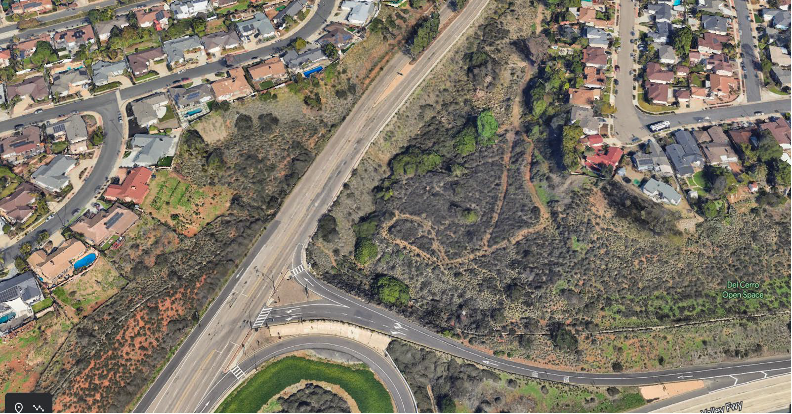
Over the last seven years, the Church has been working to obtain site plan approval to construct a new structure for its members to worship at. The Property itself is an ideal location for Church members, as it abuts a couple of residential development areas, a gas station, and a synagogue.
Even with multiple worship services hosted at its current location, the Church is unable to worship as a unified congregation, which impedes members’ ability to connect and build relationships. Furthermore, the Church’s inability to hold larger gatherings and services substantially burdens its ability also to host weddings, funerals, and other ministry events. In all, preventing the site plan approval and construction of the Property hinders the Church’s sincerely held religious mission of building a proper place of assembly and worship.
Relevant Background of Proposed Site Project
The property has been vacant for decades and is located within the Residential-Single Unit zone (RS-1-7) and the Navajo Community Plan area.
The Church’s proposed project on the Property includes the construction of a church/sanctuary building designed in a contemporary Spanish Colonial Revival style, as illustrated below:
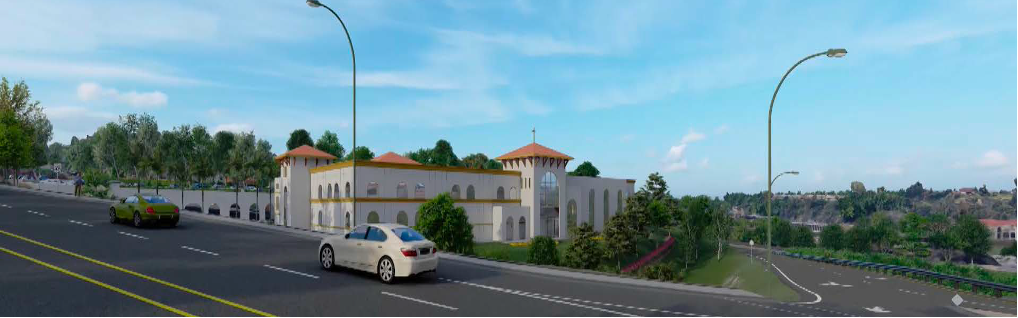
Specifically, the Church plans to construct a building that will include a 900-seat sanctuary, staff offices, Sunday School classrooms, and a multi-purpose room. The multi-purpose room will be designed for activities such as a youth room, fellowship hall, and small basketball court.
To obtain approval, the City required the following materials be provided, as shown in a City Report to the Planning Commission:
- A Land Use Plan Amendment per San Diego Municipal Code Section 122.0105(b) (“SDMC”), to amend the Navajo Community Plan.
- A Planned Development Permit pursuant to SDMC Section 126.0602(a)(2) to allow for the church use on the Project site.
- A Site Development Permit (“SDP”) in accordance with SDMC Section 126.0502(a)(2) to allow for development on property with Environmentally Sensitive Lands; and
- A Tentative Map pursuant to SDMC Section 125.0430 for a one-lot Parcel Map to consolidate the ownership interest and for the vacation of a sewer, drainage and slope easements.
In regard to the Amendment, City staff instructed All Peoples Church the Navajo Community Plan had to be amended as it did not provide a separate land use designation for places of religious assembly and did not permit places of religious assembly uses as part of the Other Community Facilities map. The proposed amendment to the Navajo Community Plan would allow the site to retain its RS-1-7 zoning, per City staff’s request, and would designate the Property for church use on the Other Community Facilities map.
Site Plan Approval Process
All Peoples Church has spent the last seven years seeking approval to develop its project on the Property. This has involved various time-consuming and costly reviews, including environmental impact and traffic studies prepared pursuant to the California Environmental Quality Act (“CEQA”). The Church retained a team of land use professionals and environmental consultants to create a development plan for the site. This team consisted of some of the top technical subject matter experts to analyze every detail and ensure the project would function effectively without impacting the surrounding community. Every aspect was meticulously analyzed, including noise, visual, biological, and traffic effects.
The Environmental Impact Report (“EIR”) and associated Transportation Analysis, both prepared in accordance with the City’s direction and guidance, determined that the Project would result in a less significant transportation impact. Specifically, a Vehicle Miles Traveled (VMT) analysis was conducted as part of the environmental review and found that the Project was presumed to have a less than significant impact because it would generate only 280 average daily trips on weekdays. The EIR further determined that the Project would not cause land-use noise compatibility issues or expose people to current or future transportation noise levels that exceed local standards. Ultimately, the EIR adopted by City staff concluded that the Project would not cause significant unmitigated environmental impacts pursuant to CEQA.
Furthermore, under the associated Community Plan Analysis, it was found that the proposal to add church use to the site would not create any inconsistencies with the policies in the Navajo Community Plan Goals and Recommendation Consistency Evaluation.
On July 19, 2018, the City’s Planning Commission held a public hearing to consider the request for an amendment to the Navajo Community Plan, which it ultimately approved. That same summer, the Church launched a public engagement effort to advance the pursuit of a new home for its congregation. All Peoples participated in numerous meetings over several years with neighboring Del Cerro residents and the broader Navajo community to build relationships and gather input on the overall project.
Church leadership met in May 2019 with the Del Cerro Action Council and Navajo Community Planners about the proposed Project. The initial tone of these meetings was positive and constructive; however, it unfortunately shifted when a new group of residents, most of whom live near the site, formed to oppose the Project. They created an ad hoc opposition group called “Save Del Cerro.” These opponents effectively harassed the Del Cerro Action Council into dissolution and forced out members of the Navajo Community Planners Committee who were favorably disposed toward the Project, in a campaign effort to fill the Committee with anti-Church activists.
As a result, the feedback included insults, false accusations, and a clear intent to discriminate against the church’s use of the property. These accusations even extended to harassment of project team members. One such incident led to a lawsuit and a judgment against one of the project opponents for their inappropriate actions. Despite this harassment and the numerous false and defamatory accusations, the church continued with the city’s process.
On September 21, 2023, City staff submitted its report to the Planning Commission with their recommendations and review approving the Project as proposed. This Report included city officials’ adoption of the Church’s EIR, and approval of its Transportation Analysis.
On September 28, 2023, the Planning Commission held a hearing to consider whether to recommend approval to the City Council for the amendment to the General Plan and Navajo Community Plan concerning the addition of a church land use designation. After reviewing the Church’s EIR and various related analyses, the Commission overwhelmingly approved the Project and recommended that the City Council certify the EIR. In its approval, the Planning Commission imposed several conditions to address concerns raised by community members. The Church subsequently incorporated these conditions into its Project for submission to the City Council.
On January 9, 2024, the City Council held its hearing on the proposed project. Assistant City Attorney Leslie Fitzgerald specifically instructed the Council that its decision regarding the project was subject to the Religious Land Use and Institutionalized Persons Act, 42 U.S.C. § 2000c et seq.
During this meeting, civil engineering and traffic experts explained the infrastructure improvements the Church would implement and detailed why the Project would not lead to any transportation impacts. Specifically, Marcela Escobar-Eck, Chief Executive Officer of Atlantis Group, reviewed the EIR and confirmed its analysis that the Project would not result in any significant unmitigated impacts. Ms. Escobar-Eck provided nine examples of other places of worship that were permitted to locate in RS-1-7 zoning and near residential developments in the Navajo Community Plan area, as well as in other community areas.
However, after a daylong hearing, the City Council denied the Church’s project with a split vote. The justification represented a twisted distortion of the City’s rules and was even in conflict with Ms. Fitzgerald’s own warnings regarding federal protections against discrimination of religious institutions. It also directly contradicted the City’s professional staff recommendations and established procedures. Consequently, due to the unjust denial, All Peoples Church filed a lawsuit against the City in Federal Court around March 25, 2024.
The Legal Battle
The City Council’s initial rejection of the church’s proposal in January 2024 led the church to file a federal lawsuit, claiming that the city violated its religious freedom rights. The church contended that the city’s decision was discriminatory and that it faced stricter scrutiny than secular projects would receive.
The Religious Land Use and Institutionalized Persons Act (RLUIPA) is a federal law that prohibits government land use regulations that substantially burden religious exercise unless the government can demonstrate that the burden is the least restrictive means of furthering a compelling governmental interest.
In light of RLUIPA, the City Council ultimately reversed its previous decision and approved the church’s project. This decision was likely influenced by the potential legal ramifications of denying the church’s proposal, including the possibility of costly litigation and the potential for a court ruling against the city.
A Victory for Religious Freedom
The March 10, 2025 approval of All People’s Church is a significant victory for religious freedom in San Diego. It affirms the right of religious institutions to build places of worship and carry out their missions without undue government interference. This decision highlights the importance of RLUIPA in protecting the religious liberties of individuals and institutions. It underscores the need for cities and municipalities to carefully consider the potential impact of land use regulations on religious exercise. It also sends a message that religious freedom is a fundamental right that must be respected and protected.
Looking Ahead
While the approval of All People’s Church is a positive development, it is important to recognize that challenges to religious freedom remain. As our society continues to evolve, it is crucial to have open and respectful dialogue about the role of religion in public life.
The approval of All People’s Church is a victory for religious freedom in San Diego. It is a reminder that religious institutions play a vital role in our communities and that their rights must be protected. As we move forward, it is important to continue to work towards a society where all individuals, regardless of their religious beliefs, are treated with respect and dignity.
If your religious institution is having issues with your local community for site plan approval, please reach out to Daniel Dalton or one of the professionals at Dalton & Tomich PLC to discuss your case.
