
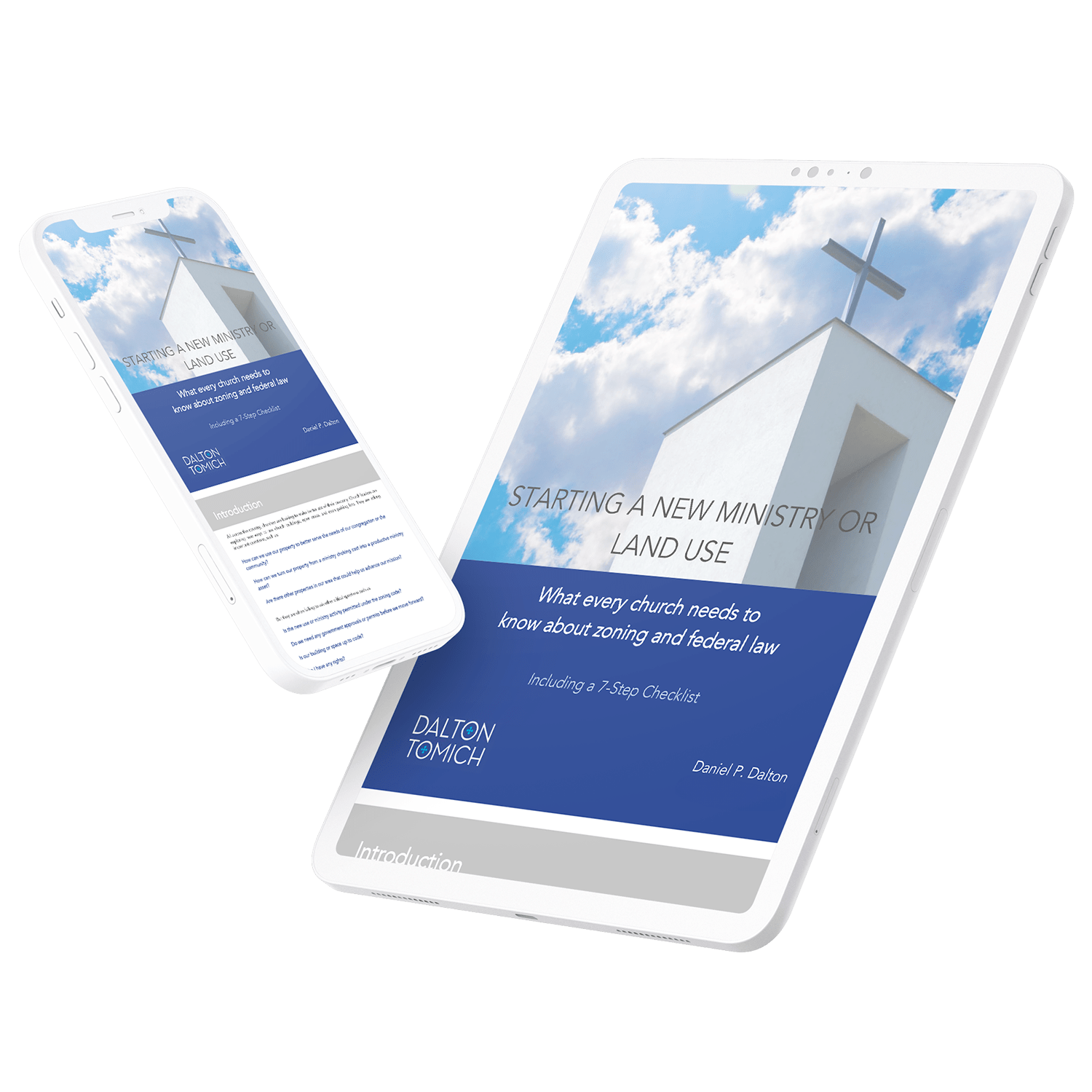
GET YOUR FREE GUIDE
7 Steps to Starting a New Ministry at Your Church
A Land Use and Zoning Guide for Faith-Based Sober and Recovery Homes and Rescue or Homeless Missions Understanding Your Rights Under Federal Law
What Every Rescue Mission, Sober Home, and Recovery Ministry Needs to Know About Its Zoning Rights
Maybe a neighbor raised a concern at a public meeting. Maybe the city sent a letter citing an ordinance you’d never heard of. Or maybe a permit that seemed like a formality suddenly isn’t moving.
Today, rescue missions, faith-based shelters, and sober living homes face more pushback on land use approvals than ever before. Sometimes it comes from a handful of concerned neighbors or an organized opposition group. Sometimes it comes from a city that simply isn’t sure how to categorize a ministry that doesn’t look like a traditional church.
Wherever you are in the process, here’s the first thing to know: you’re not the first ministry to face this, and the law is on your side more often than you might think.
Three Federal Laws That Work Together to Protect You
- The Fair Housing Act protects people recovering from addiction from housing discrimination. A city generally cannot use occupancy limits, “family” definitions, or similar zoning tools to keep out a recovery home because of who lives there.
- The Americans with Disabilities Act (Title II) applies directly to state and local governments, including the zoning board, planning department, and code enforcement office. A city must consider reasonable changes to its own rules when needed to avoid discriminating against people in recovery.
- The Religious Land Use and Institutionalized Persons Act (RLUIPA) protects a religious organization’s ability to carry out its mission on land it owns or leases. It can stop a city from treating your ministry worse than a comparable secular organization or using zoning technicalities to shut it down.
Each law covers ground the others don’t. Used together, they often make a far stronger case than any one law alone. The U.S. Constitution and many state laws can add even more protection.
Get Help from Attorneys Who Handle These Cases
Call us today at (313) 859-6000.
Fill out the form below and download your FREE guide.
Download the Guide to Discover:
- What you need to know about starting a new ministry at your church
- A seven-step checklist for starting a ministry at your church
- Your legal rights
- How to avoid zoning pitfalls before they arise
Fill out the form below and download your FREE guide.
No Attorney-Client Relationship or Confidentiality.
A visit to our website, or an inquiry from this site to one of our attorneys or staff members, does not create an attorney-client relationship between you and Dalton & Tomich PLC. For this reason, we caution you not to send us any information about a legal matter until after you have spoken with one of our attorneys and received instructions about what information to provide him or her. Unsolicited information that you send to Dalton & Tomich PLC will not be treated as confidential. While we would like to hear from you, we cannot represent you or advise you whether you have a claim until we know that there is no conflict of interest. In addition, as the Internet is not a guaranteed secure environment, information sent via the Internet by form or e-mail might be intercepted and read by third parties. A telephone number is provided on each attorney’s biography page.
