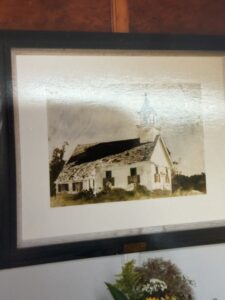
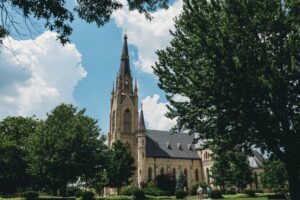
Broad Cove Church fights to maintain its property
The church wants to stand by its truth: Broad Cove Church has always belonged to the Cushing community, and it still does.

The church wants to stand by its truth: Broad Cove Church has always belonged to the Cushing community, and it still does.

For decades, Florida has stood as a legal island in a shifting sea of religious property law. While the majority of the United States has moved toward treating church property disputes like any other secular contract or trust, Florida has remained steadfast in its “hands-off” approach. However, a recent and potentially earth-shaking decision by the First District Court of Appeal (DCA) in First United Methodist Church of Hobe Sound v. The Board of Trustees of the Florida Annual Conference of the United Methodist Church has signaled that the status quo may be about to crack.

The landscape of American Methodism is changing, and for many churches, this has brought them to a crossroads. Recently, our team had the privilege of

The trend of disaffiliation is accelerating in 2026, but the “flavor” of these departures has changed. We are no longer just seeing mass exits from the United Methodist Church (UMC) under temporary provisions like Paragraph 2553, which expired in 2023.

The recent announcements regarding the financial troubles of major religious denominations raise significant concerns for local churches. These developments not only threaten the stability of larger organizations but also cast a shadow on the resources and support available to individual congregations.

In McMahon v. World Vision, Inc., the U.S. Court of Appeals for the Ninth Circuit reversed a lower court’s decision. It affirmed World Vision’s constitutional

The profound significance of this ruling is twofold. It underscores that informal, relational “membership” and unwritten expectations are legally insufficient. For a religious organization, strong, formal corporate governance and well-documented policies are the essential foundation for legal autonomy and self-preservation. The case powerfully demonstrates that a religious body’s ability to protect its mission and assets is contingent on its willingness to align its internal structure with secular corporate law and constitutional principles. The Wimber decision highlights a clear synergy between adhering to secular corporate law and leveraging constitutional protections.

The legal dispute between Southern Methodist University (SMU) and the United Methodist Church’s (UMC) South Central Jurisdictional Conference is a multifaceted case rooted in a century-old relationship. At its core, the conflict arose from SMU’s unilateral decision in 2019 to amend its articles of incorporation and declare independence from the UMC, a move that directly contravened the university’s founding documents. This action, which was precipitated by the UMC’s internal doctrinal conflicts over LGBTQ+ issues, sparked a protracted legal battle that ascended to the Texas Supreme Court.

The Free Exercise Clause of the First Amendment has been shaped by cases involving the ministerial exception for religious organizations. An example is Rohde v.

In the July 2025 decision of Family Federation for World Peace and Unification International v. Hyun Jin Moon, the District of Columbia Court of Appeals upheld
Please note that this website may be considered attorney advertising in some states. Prior results described on this site do not guarantee similar outcomes in future cases or transactions.